Bespoke Services


[Participatory Artwork]
Who Told You This Smells Like a Woman?
Satellite Project of Kyoto YouMe Triennale
2026
oneroom29, Kyoto, Japan
Who Told You This Smells Like a Woman? is a participatory olfactory installation that investigates how fragrances acquire social meaning, and how these meanings shape our understanding of gender, beauty, and identity.
We describe fragrances as feminine, masculine, elegant, clean, seductive, or professional. These associations often feel self-evident, yet they do not reside inherently within the scents themselves. They emerge through language, culture, memory, advertising, and social norms, becoming familiar through repetition until they are accepted as common sense.
The installation presents four fragrances developed around familiar cultural categories: CUTE, ELEGANT, SEXY, and CLASSIC. Rather than displaying brand narratives or ingredient descriptions, each fragrance is accompanied by a word left by a previous visitor. One person might describe a scent as Elegant, another as Lonely, while someone else might choose Mother, Artificial, or Powerful. Each visitor encounters both the fragrance and the accumulated language surrounding it, before contributing a new interpretation.
Participants are invited to write a word of their own, replace the existing word with it, and place the removed word in an archive box. In this ongoing exchange, fragrance is translated into language, and language is translated back into fragrance. Yet translation is never complete. Interpretations diverge, meanings shift, and each encounter introduces new possibilities. The words collected throughout the exhibition become an evolving archive of how people perceive and interpret the same scents.
The work is concerned not simply with translation, but with mistranslation: the moment when meaning departs from its assumed course and something unexpected emerges. Mistranslation is not necessarily a failure of communication. It can reveal the cultural frameworks through which we understand the world, exposing how meanings are constructed, repeated, and eventually normalized. Femininity, in this sense, is not an essential quality contained within a person or an object, but something continually produced through naming, interpretation, repetition, and social convention. A fragrance, likewise, possesses no inherent gender until language and culture assign one to it.
Following the exhibition, the project continued through After the exhibition, an ongoing research and documentation process that revisited the four fragrances alongside the words collected from visitors. The archive examines the reference perfumes and compositional structures behind the four accords, the materials shared across them, the language contributed by participants, and the categories and patterns that emerged through the exhibition.
Although the four fragrances were deliberately constructed to evoke distinct social identities, they shared several materials. The same ingredients could participate in scents perceived as CUTE, ELEGANT, SEXY, or CLASSIC. Their meanings, however, were not shared. The archive makes this distinction visible, bringing the material construction of fragrance into dialogue with the cultural frameworks through which it is interpreted.
The accumulated words and their unexpected associations became an integral part of the work, extending the installation into a living social dictionary that remains perpetually incomplete. Rather than providing definitive answers about gender or fragrance, the project reveals how meanings emerge, accumulate, and change through encounters between scents, language, and people.
Ultimately, the work asks not whether a fragrance is feminine, but how we came to smell it that way. Who taught us to recognize a scent as belonging to a woman? And what happens when someone gives it a different name?
《Who Told You This Smells Like a Woman?》は、香りがどのように社会的な意味を獲得し、その意味がジェンダー、美、アイデンティティに対する私たちの理解を形づくるのかを探る、参加型の嗅覚インスタレーションである。
私たちは香りを「女性的」「男性的」「エレガント」「清潔」「セクシー」「プロフェッショナル」といった言葉で表現する。こうした連想は自明のもののように感じられるが、実際には香りそのものに本質的に備わっているわけではない。それらは言語、文化、記憶、広告、社会規範を通じて生まれ、繰り返し共有されることで、やがて常識として受け入れられていく。
本作では、社会に浸透した香りのイメージをもとに制作した4つの香り、《CUTE》《ELEGANT》《SEXY》《CLASSIC》を提示する。それぞれの香りには、ブランドの物語や成分の説明ではなく、先に訪れた鑑賞者が残した言葉が添えられている。ある人は香りを「エレガント」と表現し、別の人は「孤独」と書くかもしれない。さらに別の人は「母」「人工的」「力強い」といった言葉を選ぶかもしれない。鑑賞者は、香りと、そこに蓄積された言葉の両方に出会い、自分自身の解釈を新たに加えていく。
参加者は自分の言葉をひとつ書き、展示されている言葉と入れ替え、取り外した言葉をアーカイブ用の箱に収める。この交換を通じて、香りは言葉へと翻訳され、言葉は再び香りへと翻訳される。しかし、その翻訳が完全に一致することはない。解釈は分岐し、意味は移り変わり、出会いのたびに新たな可能性が生まれる。会期中に集められた言葉は、同じ香りが人々にどのように知覚され、解釈されるのかを示す、更新され続けるアーカイブとなる。
本作が扱うのは、単なる翻訳ではなく、「誤訳」である。ここでいう誤訳とは、意味が想定された道筋から外れ、予期しなかった何かが生まれる瞬間を指す。誤訳は必ずしもコミュニケーションの失敗ではない。むしろ、私たちが世界を理解する際に用いている文化的な枠組みを浮かび上がらせ、意味がどのようにつくられ、反復され、やがて規範として定着していくのかを明らかにする。こうした観点から見ると、女性性とは、人や物に本質的に備わった性質ではなく、命名、解釈、反復、社会的慣習を通じて絶えず生み出されるものである。同様に、香りもまた、言語や文化によって意味づけられるまでは、本質的に特定のジェンダーを持つわけではない。
展覧会終了後、本作は《After the exhibition》というリサーチと記録のプロセスへと展開した。4つの香りと、鑑賞者が残した言葉をあらためて見つめ直し、それぞれの香りが参照した香水や処方の構造、4つの香りに共通する素材、鑑賞者による言葉、そして展示を通じて浮かび上がったカテゴリーやパターンを記録・分析するアーカイブである。
4つの香りは、それぞれ異なる社会的なイメージを想起させるよう意図的に構成されているが、実際には共通する素材を含んでいる。同じ香料が、《CUTE》《ELEGANT》《SEXY》《CLASSIC》という異なるカテゴリーの香りに使われているのである。しかし、それらの意味は共有されていない。アーカイブはこの違いを可視化し、香りの物質的な構成と、それを解釈する文化的な枠組みとを対比させる。
蓄積された言葉と、そこから生まれた予期しない連想は、作品そのものを構成する要素となった。こうしてインスタレーションは、決して完成することのない、生きた社会的な辞書へと拡張されていく。本作はジェンダーや香りについて確定的な答えを提示するのではなく、香りと言葉、人との出会いを通じて、意味がどのように生まれ、蓄積し、変化していくのかを明らかにする。
本作が最終的に問いかけるのは、ある香りが女性的かどうかではない。私たちは、いつ、どのようにしてその香りを女性的だと感じるようになったのか。誰が、私たちにその香りを女性のものだと教えたのか。そして、誰かがそれに別の名前を与えたとき、何が起こるのか。


[Participatory Artwork]
OASis Residency Program
Future Memories of the Park
Naples, Italy · October 2026
Future Memories of the Park is a participatory olfactory project developed during the OASis Residency Program in Bagnoli, Naples. Through workshops with young participants, the project explored how scent can become a medium for imagining collective futures and creating memories of a place that do not yet exist.
Rather than collecting memories of the past, the project invited participants to imagine how they might remember the park years from now. What plants would grow there? Who would gather in the park? What experiences, encounters, and scents might become part of its future identity? Through drawing, conversation, and scent-making, participants transformed these questions into speculative plants, imagined landscapes, and future memories.
Over three days, the participants moved from individual imagination to collective creation. On the first day, they selected materials from a collection of 50 scents to evoke their imagined future park, then invented and drew plants that do not yet exist, giving each one a name and an imagined scent. On the second day, they shared their ideas and created individual fragrances, translating their imagined futures into personal olfactory compositions. On the third day, these individual contributions were brought together in a collaborative process to create a fragrance for the future park.
Two group fragrances emerged, one created with each group of young participants. Each participant received a small bottle of the finished fragrance, placed in a metal tin alongside a scent-bearing card and a message. These Future Memory Capsules were designed to be opened in the future, preserving a sensory trace of the place and the futures imagined together.
The project also developed two fragrances inspired by Bagnoli itself. Armchair Traveler: Bagnoli, created in Japan before the artist’s arrival, imagined the area from afar through its landscape, Mediterranean coastline, volcanic soil, industrial history, and ongoing regeneration. After arriving, walking through the area, and encountering its residents, Kusunoki created Bagnoli, Up Close, a fragrance reflecting the warmth, energy, and friendliness experienced through direct contact with the place.
The final exhibition brought together these fragrances, workshop drawings, written contributions, and the Future Memory Capsule, presenting an evolving archive of imagined futures. By connecting speculative imagination with material and sensory experience, the project explored how a community might envision its future through scent—and how an imagined future might one day become a memory.
《Future Memories of the Park》は、ナポリのバニョーリ地区で開催されたOASis Residency Programにおいて展開した、参加型の嗅覚プロジェクトである。若い参加者たちとのワークショップを通じて、香りを、共有される未来を想像し、まだ存在しない場所の記憶をつくり出すための媒体として探求した。
本作が扱うのは、過去の記憶ではなく、未来に振り返ることになるかもしれない記憶である。公園にはどのような植物が育つのか。誰がそこに集うのか。どのような経験や出会い、香りが、その場所の未来を形づくるのか。参加者たちは、こうした問いを起点に、ドローイング、対話、調香を通じて、想像上の植物や風景、未来の記憶を生み出していった。
3日間のワークショップは、個々の想像から共同制作へと進んでいく。初日には、50種類の香料から未来の公園を思い描くための素材を選び、まだ存在しない植物を想像して描き、その名前や香り、生育する場所を考えた。2日目には、それぞれのアイデアを共有し、想像した未来を個人の香りとして調合した。3日目には、参加者のアイデアや言葉、植物、香りの選択を持ち寄り、全員で未来の公園を象徴する香りを完成させた。
こうして、2つのグループそれぞれから、ひとつずつ共同制作による香りが生まれた。参加者には、完成した香りを小瓶に詰め、香りを添えたカードとメッセージとともに金属製の小さな缶に収めたものを手渡した。《Future Memory Capsule》と名づけられたこのカプセルは、未来に開封することを想定している。そこには、場所の感覚と、参加者たちがともに想像した未来の痕跡が封じ込められている。
本プロジェクトでは、バニョーリという土地そのものに着想を得た2つの香りも制作した。《Armchair Traveler: Bagnoli》は、現地を訪れる前に日本で制作した香りである。土地の風景、地中海の海岸線、火山性の土壌、工業の歴史、そして再生へと向かう現在の姿を手がかりに、遠く離れた場所からバニョーリを想像した。一方、実際に現地を歩き、そこに暮らす人々と出会った後に制作した《Bagnoli, Up Close》は、直接的な関わりを通じて感じた、人々の温かさや土地の活気、親しみやすさを表現している。
最終展示では、これらの香りに加え、ワークショップで生まれたドローイングや言葉、《Future Memory Capsule》を紹介し、想像された未来のアーカイブを構成した。想像を物質や感覚の体験へと結びつけることで、本作は、地域の人々が香りを通じてどのように未来を思い描けるのか、そして想像された未来が、いつか実際の記憶へと変わりうるのかを探求する。


[Participatory Artwork]
Piano & Perfume — One Gathering, One Scent
2026
Collaborative concert and olfactory experience
Piano: Elina Akselrud and Denis Zhdanov
Fragrance and olfactory concept: Naoko Kusunoki
oneroom29, Kyoto, Japan
Piano & Perfume — One Gathering, One Scent is a collaborative project by pianist Elina Akselrud, pianist Denis Zhdanov, and perfumer and artist Naoko Kusunoki. Bringing live piano music and fragrance into dialogue, the project creates a singular, collective sensory composition shaped by the performers, the audience, and the moment itself.
Featuring works by Chopin, Debussy, Ravel, Takemitsu, and other composers, the program moves through images of water, birds, rain, flowers, and dreamlike landscapes. Five original fragrances, composed for the event, translate these impressions into olfactory form: Light Falling on Water, Inside the Green, After the Flowers, When the Rain Is Gone, and The Warmth Left Behind.
During the interlude, each audience member selects one fragrance from a collection prepared for the concert and releases it into the space. Each choice is guided by an individual response—perhaps to the music, a memory, an image, or simply a scent that feels right in the moment. As these choices accumulate, they form an ephemeral olfactory composition unique to that gathering.
The second half of the concert unfolds within this collectively created atmosphere. The audience’s fragrance selections are recorded as an Olfactory Score, a sensory notation of the event. Drawing on these collective choices, Kusunoki then composes a new fragrance that captures something of the gathering itself.
Each participant takes home two scents: the fragrance they personally selected and the fragrance composed from everyone’s choices. One holds an individual impression; the other carries the traces of a shared experience. Together, they become two forms of memory—my memory and our memory.
The work explores how music, scent, and individual perception can converge to create an experience that cannot be repeated in quite the same way. The resulting fragrance is not simply an accompaniment to the music, but a composition made through the collaboration of the pianists, the perfumer, the audience, and the moment itself.
《Piano & Perfume — One Gathering, One Scent》は、ピアニストのElina Akselrud、Denis Zhdanov、そして調香師・アーティストの楠尚子によるコラボレーションプロジェクトである。ピアノの生演奏と香りを対話させることで、演奏者と観客、そしてその瞬間によって形づくられる、一度限りの感覚的な作品を生み出す。
ショパン、ドビュッシー、ラヴェル、武満徹をはじめとする作曲家の作品を通じて、プログラムは水、鳥、雨、花、夢のような風景をめぐる。これらのイメージを嗅覚へと翻訳するため、本公演のために5つの香りを制作した。《Light Falling on Water(水面に落ちる光)》《Inside the Green(緑の内側)》《After the Flowers(花のあと)》《When the Rain Is Gone(雨が去ったあと)》《The Warmth Left Behind(残された温もり)》である。
間奏の時間には、観客一人ひとりが用意された香りの中からひとつを選び、空間へと放つ。その選択は、音楽から受けた印象や記憶、心に浮かんだイメージ、あるいはその瞬間にただ惹かれた香りによって導かれる。個々の選択が重なり合うことで、その集いにしか存在しない、一時的な香りのコンポジションが生まれる。
後半の演奏は、観客によってつくられた香りの空間の中で進行する。選ばれた香りは《Olfactory Score》として記録され、その場の感覚をとどめる嗅覚的な楽譜となる。さらに楠は、観客全員の選択をもとに新たな香りを調合し、その集いそのものをひとつの香りとして表現する。
参加者は最後に、二つの香りを持ち帰る。自分自身が選んだ香りと、その場にいた全員の選択から生まれた香り。一方には個人の印象が、もう一方には共有された体験の痕跡が宿る。二つの香りは、「私の記憶」と「私たちの記憶」という、異なる二つの記憶のかたちとなる。
本作は、音楽、香り、そして一人ひとりの知覚が交わり、同じかたちでは二度と再現できない体験を生み出す可能性を探る。ここで生まれる香りは、音楽に添えられたものではない。ピアニスト、調香師、観客、そしてその瞬間の協働によって生まれる、ひとつの作品である。


[Artbook]
Olfactophone / One Side of a Conversation
2026
Artist book, handmade, limited edition
Created for Waza Waza Iga Artbook Fair Waza Waza Iga Artbook Fair 2026
Olfactophone / One Side of a Conversation is an artist book developed from Olfactophone, a collaborative olfactory project by Naoko Kusunoki and Nadia Vitlin. Extending the project beyond exhibition and workshop formats, the book explores how a practice centered on scent, exchange, and partial understanding might be reconstituted through the material form of a book.
Rather than documenting the project retrospectively, the work incorporates fragments of the creative process, scent strips, envelopes, folded structures, insert cards, and fragrance samples. Designed as a “Portable Exhibition,” the book functions simultaneously as a medium of information and a physical structure to be opened, handled, and explored. Its contents do not follow a fixed sequence or prescribe a singular reading. Notes emerge from pages, scents remain concealed, and fragments are inserted or displaced, allowing meaning to develop through the reader’s physical engagement with the object.
This material structure reflects a central concern of Olfactophone: communication shaped by partial understanding, where meaning emerges through exchange rather than complete translation. The book does not attempt to preserve an experience in its entirety. Instead, it creates conditions for fragments to encounter one another, leaving room for ambiguity, reinterpretation, and individual perception.
Scent-based works and the conversations that surround them are often ephemeral, disappearing with the end of an exhibition or workshop. By treating the book not simply as a vehicle for information but as an object involving scent, material, and touch, the project seeks to retain something of these transient encounters. Its handmade, limited-edition form embraces the irreproducibility of experience, resisting the uniformity of digital documentation and conventional publication.
Presented at Waza Waza Iga Artbook Fair, the work enters a context in which the boundaries of the book as a medium are open to reconsideration. Its encounter with readers is not conceived merely as the circulation of a publication, but as an opportunity for the work to be read differently, misread, and reinterpreted. The book thus extends Olfactophone beyond the exhibition space, continuing its exploration of how meaning emerges through incomplete communication and the encounter between different perceptions.
《Olfactophone / One Side of a Conversation》は、楠尚子とナディア・ヴィトリンによる共同嗅覚プロジェクト《Olfactophone》から展開したアーティストブックである。展示やワークショップという形式を超えて、香り、交換、そして部分的な理解を軸とする実践を、本という物質的な形式によって再構成することを試みる。
本作は、プロジェクトの事後的な記録集ではない。制作過程の断片、試香紙、封筒、折り構造、差し込みカード、香りのサンプルなどを組み合わせ、ひとつの「Portable Exhibition(持ち運べる展覧会)」として設計されている。本は情報を伝える媒体であると同時に、開き、触れ、手を動かしながら探索する物理的な構造体でもある。内容は固定された順序に従わず、ひとつの読み方を指定しない。ページからメモが現れ、香りが隠され、断片が差し込まれたり移動したりすることで、読者が物体としての本に関わるなかから意味が立ち現れる。
この物質的な構造は、《Olfactophone》の根底にある、部分的な理解を通じて成立するコミュニケーションという考え方を反映している。意味は完全な翻訳によって伝達されるのではなく、断片的な理解や交換を通じて生まれていく。本作は、ひとつの体験を余すところなく保存することを目指さない。むしろ、断片同士が出会うための条件をつくり、曖昧さや再解釈、個々の知覚が入り込む余地を残している。
香りを用いた作品も、そこで交わされる会話も、展示やワークショップの終了とともに消えてしまうことが多い。香りや素材、手触りを伴う物体として本を捉えることで、本作は、そうした一過性の出会いの何かを留めようとする。手作業による限定少部数の形式は、デジタルな記録や均質化された出版物とは異なり、体験を完全には複製できないという性質を受け入れるものである。
Waza Waza Iga Artbook Fairへの出展を通じて、本作は、本というメディアの境界そのものが問い直される場に置かれる。読者との出会いは、単に出版物を流通させることではなく、作品が異なる読み方をされ、誤読され、再解釈される機会として捉えられる。本作は、展示空間の外へと《Olfactophone》を拡張し、不完全なコミュニケーションと異なる感覚同士の出会いから意味が生まれる過程を、引き続き探求する。


[Participatory Artwork]
Contemporary KODO
2026
Participatory event combining perfumery, tanka poetry, and dialogue
Concept and curation: Naoko Kusunoki
In collaboration with tanka poet Haruka Suzuki
oneroom29, Kyoto, Japan
Contemporary KODO reinterprets the traditional practices of kōdō (the Japanese Way of Incense) through contemporary perfumery and tanka poetry. In the traditional culture of kōdō, participants listened to incense, composed poetry, bestowed names upon fragrances, and engaged in playful contests of aesthetic sensitivity. This project revisits these forms of cultural play through three interconnected practices: Kikō Kakai, a poetry gathering in which participants listen to fragrances and compose tanka; Gendai Takimono-awase, a contemporary reinterpretation of fragrance contests in which participants create perfumes and compete in naming them; and Kōdan, a dialogue on kōdō, tanka, and perfumery.
In Kikō Kakai, participants experience fragrances created by a perfumer and translate their impressions into tanka. Rather than ranking the poems, the gathering celebrates the diversity of language and interpretation that can emerge from a shared olfactory experience.
In Gendai Takimono-awase, participants combine fragrance bases to create their own perfumes, giving each composition a name inspired by tanka poetry. The completed works are then presented for collective smelling and appreciation, with discussion focusing on both the fragrances and their names.
The gathering concludes with Kōdan, an open conversation on the history of incense games and fragrance contests, the relationship between poets and scent, and contemporary expressions of perfumery. A final social gathering extends the exchange, as participants revisit their creations over drinks and light refreshments.
Moving between smelling, composing, naming, and conversation, Contemporary KODO creates a shared space in which fragrance and language continually inform one another. Neither a fragrance workshop nor a poetry gathering alone, the project explores how attending to scent can become a form of expression, interpretation, and exchange.
《Contemporary KODO》は、香道における伝統的な遊びを、現代の香水と短歌によって再解釈する試みである。香道の文化において、人々は香りを「聞き」、歌を詠み、香りに名を与え、互いの感性を競い合ってきた。本作は、こうした伝統的な実践を、三つのプログラムを通じて現代に展開する。香りを聞いて歌を詠む「聞香歌会」、香りを制作し、その名を競う「現代薫物合」、そして香道・短歌・香水について語り合う「香談」である。
「聞香歌会」では、調香師が制作した香りを聞き、その印象を短歌として表現する。ここで重視されるのは、作品の優劣を決めることではなく、同じ香りとの出会いから生まれる多様な言葉や解釈を味わうことである。
「現代薫物合」では、参加者がフレグランスベースを組み合わせて香りを制作し、短歌に触発された香銘を与える。完成した作品は参加者全員で聞香し、香りそのものと、それに付された名前の双方から鑑賞し、講評し合う。
続く「香談」では、香道における組香や薫物合の歴史、歌人と香りの関係、現代における香水表現などを題材に対話を行う。最後には、制作した香りを改めて試しながら、飲み物や軽食を囲んで交流する時間が設けられる。
香りを聞き、歌を詠み、香りを作り、名を与え、語り合う。《Contemporary KODO》は、これらの実践を往還することで、香りと言葉が互いに作用し合う場をつくり出す。香水を作るだけでも、詩を詠むだけでもない本作は、香りに注意深く向き合うことが、表現や解釈、そして他者との感性の交換へとつながる可能性を探る。


[Exhibition]
Olfactophone
Pink Melancholy / Grey Daydream / Taste of Gold / Noisy Black / Clouds of Teal / Liminal Blue
2025
Yellow Sorrow / Silver Rain / Lilac Deceit / Burgundy Thunder / Swift White / Intimate Beige
2026
Dimensions variable
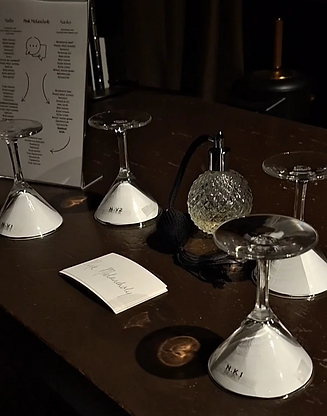
Fragrance, glass funnels, plastic cups, and glass cloches
The Secret Bar Nakameguro, Tokyo 2025
Airspace Projects, Sydney 2026
Artist: Naoko Kusunoki, Nadia Vitlin
Olfactophone is a collaborative olfactory project by Naoko Kusunoki and Nadia Vitlin that explores scent as a form of relational language.
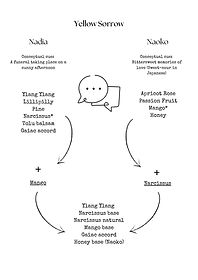
First presented in Tokyo in 2025, Olfactophone began as an experiment in collaborative perfumery. In that initial iteration, the two perfumers worked from shared themes—such as color, landscape, texture, and emotion—to create individual fragrances, exchanging insights into their processes and the materials they used. Through this iterative dialogue, the fragrances gradually converged into a single collaborative scent, foregrounding perfumery as a process of relation rather than representation.
At its core, the project recognizes that scent resists fixed vocabulary and complete translation. Historically, perfumery has addressed this instability by borrowing metaphors from other senses, resulting in poetic yet culturally specific frameworks. Olfactophone proposes an alternative approach: using scent itself as a provisional language, similar to a pidgin—one that functions through relation rather than fluency.
Rather than presenting fragrance as an ambient effect or a finished object, Olfactophone Sydney foregrounds process: listening, responding, and negotiating through smell. The project proposes perfumery as a space of encounter—where language does not precede relation, but emerges from it.
The work takes shape through Olfactory Dialogue Workshop, a participatory format that translates the collaborative process of the project into an experience open to visitors. Rather than serving as an accompanying program, the workshop constitutes an integral part of the artwork.
Participants select a shared theme that resists easy translation into scent, such as a color, an emotion, or a memory, and develop a fragrance through the exchange of ideas, interpretations, and perfumery techniques. As individual perceptions encounter and influence one another, a shared expression gradually emerges.
By placing visitors within this process of negotiation and creation, the work makes tangible its central proposition: that scent can become a medium for dialogue, through which a common language emerges not from predefined meanings, but from the encounter between different perceptions.
《Olfactophone》は、楠尚子とナディア・ヴィトリンによる共同嗅覚プロジェクトであり、香りを人と人との関係を結ぶ言語として捉え、その可能性を探求する。
2025年に東京で初めて発表された本プロジェクトは、共同調香の実験として始まった。初回の試みでは、色彩、風景、質感、感情といった共通のテーマをもとに、二人の調香師がそれぞれ独自の香りを制作し、その制作過程や使用する素材について互いの知見を交換した。こうした反復的な対話を通じて、個々の香りは徐々にひとつの協働による香りへと収束していった。そこでは、調香は何かを表象する行為というよりも、他者との関係性を築いていくプロセスとして浮かび上がる。
本プロジェクトの根底にあるのは、香りが固定された語彙や完全な翻訳になじまないという認識である。歴史的に、調香の世界では、この不安定さを補うために他の感覚から比喩を借りてきた。それによって詩的な表現が生まれる一方、香りの語り方は文化ごとに固有の枠組みにも規定されてきた。これに対し、《Olfactophone》は、香りそのものを暫定的な言語として用いる、新たなアプローチを提案する。それは、流暢さや共通の語彙によってではなく、関係性を通じて機能する、ピジン(異なる言語を話す人々の間に生まれる接触言語)のような言語である。
香りを空間に漂う演出効果や完成されたオブジェとして提示するのではなく、《Olfactophone》は、嗅ぐことを通じて互いの表現に耳を澄まし、応答し、交渉するというプロセスそのものを前景化する。本プロジェクトは、調香を他者と出会うための場として捉える。そこでは、言語が関係に先立って存在するのではなく、関係のなかから言語が立ち上がってくる。
さらに本作は、プロジェクトの協働的な制作プロセスを来場者が体験できるかたちへと展開する、参加型の《Olfactory Dialogue Workshop》を通じて成立する。このワークショップは、作品に付随するプログラムではなく、作品そのものを構成する不可欠な要素である。
参加者は、色彩や感情、記憶など、香りへと容易には翻訳できない共通のテーマを選び、アイデアや解釈、調香技法を交換しながら、ひとつの香りをつくり上げていく。異なる個々の感覚が出会い、互いに影響を及ぼすなかで、ひとつの共有された表現が徐々に立ち現れる。
来場者をこの交渉と創造のプロセスに招き入れることで、本作はその中心的な考えを具体的な体験として提示する。すなわち、香りは対話の媒体となりうること、そして共通の言語はあらかじめ定められた意味からではなく、異なる感覚同士の出会いから生まれうるということである。





[Exhibition]
CAFE (Contemporary Art Fragrance Exhibition)
2026
Dimensions variable
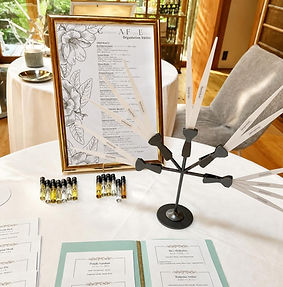
Fragrance, perfume bottles, furniture, printed menu
oneroom29, Kyoto
Curator/Artist: Naoko Kusunoki, Nadia Vitlin
Artists: Katrina Cochrane, Clayton Ilolahia, Bhakti Gandhi, Daniel Pescio
CAFE (Contemporary Art Fragrance Exhibition) is an experimental, interactive exhibition that approaches fragrance as a form of contemporary art through the familiar structure of a café. Rather than presenting scent as a product or object, the project repositions it as a temporal and experiential medium.
Set within a restored Kyoto machiya townhouse, the domestic living–dining–kitchen space is reconfigured into a café-like environment where perfume and café culture symbolically exchange roles. Fragrances are displayed on the counter, scents appear on the menu, and visitors are invited to choose, sit, and spend time with a scent.
The project begins with a simple question: why are there countless cafés, yet no equivalent spaces for engaging with fragrance in a similarly attentive way? In response, CAFE proposes time, attention, and presence as essential conditions for olfactory experience.
Featuring artists from five countries—Japan, Australia, New Zealand, India, and Brazil—the exhibition frames fragrance as a social and spatial practice, unfolding through shared time and collective presence.By inhabiting rather than rejecting the structure of a café, CAFE operates as a subtle intervention into everyday life.
CAFE(Contemporary Art Fragrance Exhibition)は、誰もが親しみのあるカフェという形式を通じて、香りを現代アートとして捉え直す、実験的かつ参加型の展覧会である。香りを商品やオブジェとして提示するのではなく、時間と体験を通じて立ち現れる表現媒体として位置づける。
京都の町家を再生した空間を舞台に、もともとのリビング、ダイニング、キッチンからなる生活空間を、カフェのような場へと再構成する。そこでは、香水とカフェの文化が象徴的に役割を交換する。カウンターには香りが並び、メニューには香りが記される。来場者は香りを選び、席に着き、その香りとともに時間を過ごすことができる。
本プロジェクトは、ひとつの素朴な問いから始まる。街には数え切れないほどのカフェがあるのに、座ってじっくりと香りと向き合い、その体験に時間を費やすための場所は、なぜ存在しないのだろうか。この問いに応えるべく、CAFEは、香りを体験するための本質的な条件として、時間、注意、そしてその場にいることそのものを提示する。
日本、オーストラリア、ニュージーランド、インド、ブラジルの5か国から参加するアーティストたちによって構成される本展は、香りを、共有される時間と人々がともに居合わせることを通じて展開する、社会的かつ空間的な実践として捉える。カフェという形式を拒絶するのではなく、むしろそのなかに身を置くことで、CAFEは日常のあり方に静かな介入を試みる。


[Exhibition]
Scented Absence
2025
The Uncommon, Hong Kong
Artist: Nadia Vitlin, Naoko Kusunoki
Curator: Joyce Mak
Inspired by Kenya Hara, "A vessel that's empty has the possibility to hold things inside. Similarly, abundance lies in the possibilities that exist before anything occurs." This exhibition explores the richness of emptiness as a fertile ground for creation and possibility. What does it mean to exist within the void? Is the question lies at the heart of the exhibition. This journey will challenge you to embrace the potential that lies in the void, where abundance awaits before anything materialises. It speaks the language of emotions, urging us to "see nothing, feel everything”.
As you wander through "Scented Absence", let the aromas awaken forgotten memories and stir your emotions. Allow each scent to deepen your connection with the world around you, revealing layers of beauty often overlooked. Celebrate not only what you see, but what you feel, and rediscover the joy of living through the alchemy of scent.
Joyce Mak
原研哉の「空っぽの器は、何かを受け入れる可能性を秘めている。同じように、豊かさとは、何かが起こる前に存在する可能性のなかにある」という思想に着想を得て、本展は、創造と可能性を育む土壌としての「空」の豊かさを探求する。
虚無のなかに存在するとは、どういうことなのか。それが本展の核心にある問いである。本展をめぐる旅は、何かが形を成す前から豊かさが宿る、空白のなかに潜む可能性を受け入れることへと私たちを誘う。感情の言語を通じて、「何も見ず、すべてを感じる」という体験を呼びかける。
《Scented Absence》の空間を巡りながら、香りが忘れていた記憶を呼び覚まし、感情を揺さぶるのに身を委ねてほしい。それぞれの香りを通じて、身のまわりの世界とのつながりを深め、見過ごされがちな美しさの幾層もの広がりを発見してほしい。目に見えるものだけでなく、心で感じるものを讃え、香りの錬金術を通じて、生きることの喜びをあらためて見出してほしい。
ジョイス・マック
In Absentia 2025 Canvas, modeling paste, acrylic, fragrance
Concept: The one who is not there. The place where you are not. Scent concept: A powdery, glowing invisibility of existence
Oblivion 2025 Canvas, modeling paste, acrylic, fragrance
Concept: When all the world knows except you. Lost in the lack of consciousness. Scent concept: Opaque, confusing nothingness
Empty-Handed 2025 Cloche, clay, fragrance
Concept: Once again I failed to bring the right thing. Scent concept: A sparkling, beautiful object that is not there
The Vacancy 2025 Curtain, fragrance
Concept: This is an empty space. However, not anymore, because you are reading this. Scent concept: Liminality
A Physical Void 2025 Paper, metal clip, fragrance
Concept: Contribute to the void. Take one with you. Scent concept: Grounded, but missing
Exodus 2025 Fog machine, fragrance
Concept: Create your absence: evacuate. Scent concept: Transparent wood
Invisible Rose / Bois Disparu 2025
Grass bottle, paper, fragrance


[Fragrance Art Project]
Fantasy Flora—Winter Series
The Pulse Beneath the Silence
2025
Dimensions variable
Scent diffusor, fragrance, paper, digital picture frame, paper, stainless steel, metal
Included in the exhibition
Shinrabansho 森羅万象
MUSUBI Kiyosumishirakawa, Tokyo
2025
Developed through a sustained dialogue between human and AI, this series explores how scent can give form to what does not exist in nature. Each perfume interprets an imagined winter flora—constructed through language, data, and intuition.
Through the act of naming and designing these fictional species, the boundaries between perception, memory, and invention begin to blur. A fragrance created for something unreal can still evoke a sense of recognition— as if one has encountered it before, somewhere in the folds of experience.
In that moment, imagination begins to resemble memory, and fiction acquires the quiet texture of the real. These works trace that subtle transition, where absence takes on presence, and silence reveals its pulse.
人間とAIとの継続的な対話を通じて制作された本シリーズは、自然界には存在しないものに、香りによっていかに形を与えられるかを探求する。それぞれの香水は、言葉とデータ、そして直感を通じて構築された、想像上の冬の植物相を表現している。
架空の種に名前を与え、その姿をデザインする行為を通じて、知覚と記憶、そして創造の境界は次第に曖昧になっていく。実在しないもののためにつくられた香りであっても、どこかで出会ったことがあるかのような、不思議な既視感を呼び起こすことがある。それは、これまでの経験の襞のどこかに、かつて触れたものが潜んでいるかのような感覚である。
その瞬間、想像は記憶に似はじめ、フィクションは静かに現実の手触りを帯びていく。本作は、不在が存在感を獲得し、沈黙がその鼓動をあらわにする、その繊細な移行の軌跡をたどる。
No. 1 Glacialis Frond
Top: Frost Mint Middle: Snow Lavender Base: Crystal Moss
No. 2 Frostmourn
Top: White Peach Middle: Powder Snow Base: White Musk
No.3 Brumal Thorn
Top: Silver Bergamot Middle: Frost Rose Base: White Amber
No. 4 Crysalin
Top: Pure Water Middle: Snowdrop Base: Cashmere Wood
No. 5 Aurefleur
Top: Citrus Zest Middle: Mimosa Base: Honey Amber
No. 6 Nivalis Heart
Top: White Pear Middle: Transparent Jasmine Base: Vanilla cream
No. 7 Silvanth
Top: Icy Lemon Middle: Pine Needle Base: Incense
No. 8 Velithra
Top: Frozen Berry Middle: Snow Orchid Base: Suede
No. 9 Thalora
Top: Frozen Melon Middle: Bamboo Base: Crystal Moss


[Participatory Artwork]
Beyond Proust — Exchanging Scents and Memories
2025
Dimensions variable
Fragrance, glass bottle, printer, photo, metal
Included in the exhibition
Hokkaido Photo Festa
Moerenua Park, Sapporo 2025
The phenomenon where smelling an odor instantly revives old memories is called the "Proust phenomenon," named after Marcel Proust's highly evocative description of it in In Search of Lost Time. It is classified as "involuntary memory," meaning it occurs without any conscious effort to remember.
Proust believed memories were counterfeit. Our intellects reprocess experiences and distort facts. Therefore, he opposed consciously recalling memories. That is precisely why he delighted in sudden flashbacks. He considered them closer to truth, as they avoided the weaving of false memories inherent in the act of recollection.
According to Brassai, Proust frequently used photography as a metaphor for this involuntary memory. Memory, Proust said, is "not a collection of copies of life's various events, readily accessible for viewing, but rather a kind of void from which dead memories are occasionally revived and drawn out by their resemblance to reality." He further likened "memories that never return" to "photographs that are never developed."
However, we in the modern age constantly carry devices with photographic capabilities-smartphones-allowing us to store memories and retrieve them at any time. This work uses scent as a cue, attempting to visualize memory by connecting fragrance and recollection through "voluntary memory."
プルーストにはできなかったこと—香りと記憶の交換
匂いを嗅いだ瞬間、忘れていた過去の記憶が鮮やかによみがえる。この現象は、マルセル・プルーストの小説『失われた時を求めて』に描かれた印象的な場面にちなみ、「プルースト現象」と呼ばれる。意識的に思い出そうとすることなく、不意によみがえる記憶は「無意図的想起」に分類される。
プルーストは、記憶を偽りうるものと考えていた。私たちの知性は、経験を再構成する過程で事実を変形させてしまう。そのため彼は、意識的に記憶をたどることに否定的だった。だからこそ、ふいに過去がよみがえる瞬間に喜びを見出したのである。意識的な想起に伴う虚構の介入を免れた無意図的想起こそ、より真実に近いものだと考えていた。
写真家ブラッサイによれば、プルーストはこの無意図的想起を、しばしば写真にたとえていたという。プルーストは記憶について、「人生のさまざまな出来事の複製が、いつでも閲覧できるように蓄えられているのではなく、現実との類似をきっかけに、死んだ記憶がときおりよみがえり、引き出されるような虚無なのだ」と述べている。また、二度とよみがえることのない記憶を、「現像されることのない写真」にたとえた。
しかし、写真を撮る機能を備えたスマートフォンを常に携帯する現代の私たちは、記憶を記録し、いつでも呼び戻すことができるようになった。
本作では、香りを手がかりに、香りと想起を結びつけることで、記憶を可視化することを試みる。そこでは、不意によみがえる「無意図的想起」とは対照的に、香りをきっかけとして意識的に記憶をたどる「意図的想起」というアプローチが用いられる。


[Participatory Artwork]
Time Capsule Project
2022-2023
Dimensions variable
Fragrance, PP bottle, scent diffuser, paper, acrylic box
Included in the exhibition
The House of the Living
A private house, Tokyo
2022
Sometimes, a single whiff of fragrance can bring a long-forgotten memory vividly back to life. This phenomenon, often referred to as the Proust phenomenon, is associated with involuntary memory—a form of remembering that occurs without any conscious effort to recall the past. Although widely discussed, scent-evoked memories are less commonly reported than memories prompted by visual or auditory cues.
Yet they attract particular interest because of their distinctive qualities: memories evoked by scent tend to be more enduring, vivid, detailed, and emotionally charged than those triggered by other senses.
Can such a phenomenon be deliberately created? Is it possible to encapsulate the memory of a particular day in a fragrance, like a time capsule, and evoke it again in the future?
This experimental work emerged from these questions. Participants were invited to take home an envelope containing two small bottles of fragrance, labeled 2022 and 2023. They were asked to use the first fragrance over several days, then seal the envelope and keep it for one year. After receiving a reminder by email, they would reopen the envelope, smell the second fragrance, and reflect on the memories and associations it evoked.
By separating the two encounters with scent by a year, the work explores whether fragrance can serve as a time capsule—not simply preserving a memory, but potentially creating the conditions for its return.
What will we remember? And can a scent unlock memories held within it?
香りをひと嗅ぎしただけで、長いあいだ忘れていた記憶が鮮やかによみがえることがある。この現象は「プルースト現象」と呼ばれ、「無意図的想起」——過去を思い出そうと意識することなく生じる想起——と関連づけられている。広く知られ、語られてきた現象ではあるものの、香りによって引き起こされる記憶は、視覚や聴覚の刺激による記憶ほど頻繁には報告されていない。
それでも香りによる記憶が特別な関心を集めるのは、ほかの感覚による記憶とは異なる特徴を持つためである。香りによって呼び起こされる記憶は、ほかの感覚をきっかけとする記憶に比べて、より長く持続し、鮮明で、細部に富み、強い感情を伴う傾向がある。
こうした現象を意図的につくり出すことはできるのだろうか。ある特定の日の記憶を、タイムカプセルのように香りのなかに封じ込め、未来にもう一度呼び起こすことは可能なのだろうか。
本作は、こうした問いから生まれた実験的な作品である。参加者は、「2022」と「2023」と記された2本の香りのボトルが入った封筒を持ち帰る。最初の香りを数日間にわたって使用した後、封筒を封じ、1年間保管する。1年後、メールによる通知を受けて再び封筒を開き、2本目の香りを嗅いで、そこから呼び起こされる記憶や連想について振り返る。
香りと再会するまでのあいだに1年という時間を置くことで、本作は、香りがタイムカプセルとして機能しうるかを探る。香りは単に記憶を保存するだけでなく、その記憶が再びよみがえるためのきっかけにもなりうるのだろうか。
私たちは何を思い出すのだろうか。そして、香りは、そのなかに宿る記憶を呼び覚ますことができるのだろうか。


[Fragrance / Performance Artwork]
The Scriabin Sonatas Reimagined—Part 2: 6-7-8-9-10
2024
Dimensions variable
Scent diffuser, fragrance, grass bottle
Premiered: February 29, 2024
MUMUTH, Graz, Austria
Re-interpreting the Five Late Piano Sonatas by Alexander Scriabin with a fresh look on classical music from a contemporary angle: interlacing sound, color, movement, light, scent, and space.
アレクサンドル・スクリャービンの後期ピアノソナタ5作品を、現代的な視点からクラシック音楽を捉え直す試み。音、色彩、動き、光、香り、そして空間を織り交ぜ、新たな解釈を生み出す。

No. 6 Fuzzy Amber
Dominant notes: Lotus, Powder, Incense
No. 7 Crystalline Fruity
Dominant notes: White Peach, Peony, White Musk
No. 8 Solitary Green
Dominant notes: Mint Tea, Forget-me-not, Rain
No. 9 Evil Woody
Dominant notes: Black Tea, Iris, Tobacco
No. 10 Delightful Floral
Dominant notes: Sparkling Citrus, Pink Rose, Vanilla


[Exhibition]
Flower Park—Subception
2022
Gallery Dazzle, Tokyo
Artist:
Nobuo Iida (Photo)
Naoko Kusunoki (Scent)
We live in an age dominated by vision, and flowers are no exception. Through selective breeding, flowers have become more colorful and longer-lasting, often at the expense of their fragrance. Scent is often the first thing to disappear, sacrificed in the pursuit of visual perfection and durability.
When I first encountered Iida’s photographs, I intuitively felt that they smelled good. I later came to realize that the fragrances lost through selective breeding seemed, somehow, to be contained within the images. This project grew out of my desire to give form to these “captured” scents.
In these photographs, flowers dissolve into luminous fields of color. They appear delicate yet seductive, evoking a sense of warmth and an imagined fragrance, even though they are only visible to us. It is as if they operate beneath the threshold of conscious perception—an idea encapsulated in the subtitle Subception.
For this work, I extracted colors from the images and translated them into PANTONE values, which I then used to create 40 fragrances arranged on a Scent Wheel. I subsequently recalculated the proportions of light and color and translated them once again into new scents.
私たちは視覚が支配的な時代を生きている。花もまた、その例外ではない。品種改良によって、花はより色鮮やかに、そして長持ちするようになった。その一方で、しばしば犠牲にされてきたのが香りである。視覚的な美しさと持続性を追求するなかで、香りは真っ先に失われていく。
飯田氏の写真に初めて出会ったとき、私は直感的に、そこからよい香りがするように感じた。やがて、品種改良によって失われた香りが、何らかのかたちで写真のなかにとどめられているのではないかと思うようになった。本作は、そうして「捉えられた」香りにかたちを与えたいという思いから生まれた。
これらの写真のなかで、花々は光を帯びた色彩の広がりへと溶け込んでいる。繊細でありながらも官能的なその姿は、温もりと、そこには見えない香りの気配を呼び起こす。あたかも、意識的な知覚の閾値よりも深いところで作用しているかのように。その感覚を表すのが、副題の「Subception」である。
本作では、画像から色彩を抽出し、それらをPANTONEの色番号へと変換したうえで、40種類の香りを制作し、Scent Wheel上に配置した。さらに、光と色彩の構成比を再計算し、そこから新たな香りへと再び翻訳した。
Flower Park Scent Wheel
2022
Dimensions variable
Textile, fragrance, grass bottle, table, paper
Untitled (Perfume)
2022
Dimensions variable
Fragrance, grass bottle

[Fragrance Artwork]
Le Champ du Marc
2026
Dimensions variable
Fragrance, grass bottle
Included in the exhibition
CAFE
onerrom29, Kyoto
2026
Fragrance Family: Floral Amber
TOP: Cognac Accord MIDDLE: Floral Archive BASE: Oakwood Accord
The title of this work is a strict anagram of “Marcel Duchamp.” A proper name is dismantled and rearranged to generate another meaning. Marc refers not only to residue left after pressing, but also to the traditional French pomace spirit distilled from those grape remains, transforming waste into eau-de-vie. The composition opens with this distilled note, evoking spirit and extraction. At its heart lies an archive of past attempts—fragrances once set aside, preserved rather than discarded. This accumulated “marc” forms the middle note, privileging sediment over refinement. An oakwood base suggests cask and time. As the name is reconfigured, the fragrance reveals its own layered structure.
ル・シャン・デュ・マール 残渣の野
フレグランス・ファミリー:フローラルアンバー
TOP: コニャックアコード MIDDLE: フローラルアーカイブ BASE: オークウッドアコード
本作のタイトルは「Marcel Duchamp」(マルセル・デュシャン)の厳密なアナグラムである。固有名は解体され、再配列されることで別の意味を生む。「Marc」は圧搾後に残る搾りかすを指すと同時に、その残渣を利用して生まれるフランスの蒸留酒も意味する。価値が抽出された後の物質は、再びスピリットへと転化する。本作ではその両義性を踏まえ、蒸留を想起させるトップと、樽熟成を示唆するオークウッドのベースを組み立てた。中心には、過去に制作されながら採用されなかった香りのアーカイブが据えられる。蓄積された「Marc」はミドルノートとなり、洗練よりも沈殿を優先する。名が再構成されるように、香りもまた制作の構造を露わにする。

[Fragrance Artwork]
Herbert
2025
Dimensions variable
Fragrance, grass bottle
Included in the exhibition
Volatile Derivatives
Olfactory Art Keller, New York
2025
In 1919, Jacques Guerlain created a legendary perfume called MITSOUKO. The name “Mitsuko” is instantly recognizable to anyone Japanese as a woman’s name. From the moment I first encountered this fragrance, my heart was drawn to it. Who was Mitsouko?
I soon discovered she was a character in Claude Farrell's novel La bataille (The Battle), where she falls in love with a British officer in the Royal Navy. Mitsouko was married to Sadao Yorisaka, a young Japanese marquis, and the British officer, Herbert Fairgan, was a friend of her husband. Both Herbert and Sadao died in the Russo-Japanese War. At the moment of his death, Sadao shockingly implies that he had known all along about the secret relationship between his wife and Herbert. Deeply moved by the story, I wanted to give Mitsouko and Herbert, who did not have a happy ending, a perfume as an everlasting tribute. Creating Herbert’s fragrance would be my sensory response to Mitsouko’s.
MITSOUKO, as is widely known, is a chypre floral fragrance with a fruity peach note with aldehydic C-14. But what would HERBERT's scent be like? The novel doesn’t provide a clear description, so I looked for subtle clues. I found references to ‘laurel’, ‘geranium’, and ‘tobacco’, and used these elements to compose a fragrance that would capture his essence.
1919年、ジャック・ゲランは伝説的な香水「MITSOUKO(ミツコ)」を生み出した。「ミツコ」という名は、日本人なら誰もがすぐに女性の名前だと認識するだろう。初めてこの香りに出会ったとき、私はたちまち心を奪われた。ミツコとは、いったい誰なのだろう。
ほどなくして、彼女がクロード・ファレールの小説『ラ・バタイユ(戦闘)』に登場する人物であることを知った。ミツコは、イギリス海軍の士官と恋に落ちる。彼女は日本の若き侯爵、頼坂定雄の妻であり、恋の相手であるハーバート・フェアガンは夫の友人だった。ハーバートと定雄は、ともに日露戦争で命を落とす。死の間際、定雄は妻とハーバートの秘められた関係を、ずっと前から知っていたことを衝撃的な形でほのめかす。
この物語に深く心を動かされた私は、幸福な結末を迎えることのなかったミツコとハーバートに、永遠の献辞となる香水を捧げたいと思った。ハーバートの香りを創り出すことは、ミツコの香りに対する、私自身の感覚を通じた応答となるはずだった。
「MITSOUKO」は広く知られているように、アルデヒドC-14がもたらすフルーティーな桃の香りを特徴とする、シプレ・フローラルの香水である。では、「HERBERT」はどのような香りなのだろうか。
小説には、彼の香りを明確に描写した記述はない。そこで私は、物語のなかに潜むささやかな手がかりを探した。「月桂樹」「ゼラニウム」「タバコ」への言及を見つけ、それらの要素を用いて、ハーバートという人物の本質を捉える香りを組み立てていった。

[Fragrance Artwork]
Moon Collection
2025
119 × 43 × 25 mm
Fragrance, glass bottle
Included in the exhibition
Moon Collection
MUSUBI Kiyosumishirakawa, Tokyo
2025
Inspired by four traditional Japanese seasonal expressions for the moon, these four fragrances translate the distinct moods and atmospheres evoked by each into scent.
15 — Jūgoya / The Mid-Autumn Moon
August 15th of the lunar calendar (October 6, 2025)
The moon on this night is traditionally regarded as the clearest and most beautiful of the year. Autumn grasses, the sounds of insects, night dew, and the cool autumn breeze further enhance its luminous clarity.
23 — Nijūsan’ya / The Twenty-Third Night Moon
August 23rd of the lunar calendar (October 14, 2025)
The moon rises around midnight.
13 — Jūsanya / The Later Autumn Moon
September 13th of the lunar calendar (November 2, 2025)
Known as the Later Moon in contrast to the Mid-Autumn Moon, it appears when the autumn winds have grown distinctly chilly. Unlike the splendor of the Mid-Autumn Moon, it possesses a quieter, more melancholy beauty. In Japanese tradition, viewing only one of these two moons is called katamitsuki (片見月).
Tsuki no Ame / Rain-Obscured Moon
The night of the fifteenth day of the eighth lunar month, when rain obscures the moon. One gazes up at the sky, lamenting the rain that conceals it.
月を表す四つの伝統的な季語から着想を得て、それぞれが呼び起こす異なる情景や情緒を、四つの香りへと翻訳した。
十五夜 / 中秋の名月
旧暦八月十五日(2025年10月6日)
一年中でこの月が最も澄んで美しいとされる。秋草や虫の音、夜露や秋風など、風物のたたずまいが一層月を明澄にする。
二十三夜 / 真夜中の月
旧暦八月二十三日(2025年10月14日)
真夜中の十二時ごろに出る。
十三夜 / 後の月
旧暦九月十三日(2025年11月2日)
名月に対して後の月という。吹く風ももう肌寒く感じられるころで、華やかな名月とは違い、もの寂びた趣がある。中秋の名月か後の月のどちらかしか見ないことを片見月(片月見)という。
月の雨 / 雨名月
旧暦八月十五日の夜、雨のため、月が見えないことをいう。雨をうらめしく思いながら、空を仰ぐ。
出典:『合本俳句歳時記 第五版』角川書店編


[Fragrance Artwork]
Eau de Sasa veitchii
2025
Alcohol, fragrance, DPG, distilled Sasa veitchii water, diffuser
Eau de Sasa veitchii is a perfume work created in collaboration with Eiji Ohashi’s photographic project Your Eyes Are Our Eyes. During the development of Hokkaido in the Meiji period, people repeatedly confronted Sasa veitchii as they cleared the land; today, this dwarf bamboo still appears in the landscape in much the same form. Drawing on the structures of green and bamboo notes in perfumery, the scent is composed using materials extracted from Sasa veitchii. Dispersed throughout the exhibition space, the fragrance introduces an alternative mode of connection through smell in dialogue with the act of seeing proposed by the photographs, opening a shared sensory field between past and present, self and other.
《Eau de Sasa veitchii》は、大橋英児の写真作品《Your Eyes Are Our Eyes》とのコラボレーションとして制作した香水作品である。明治期の北海道開拓において、人びとが繰り返し対峙したクマ笹は、現在も同じ姿で風景の中に存在している。本作では、香水におけるグリーンノートやバンブーノートの構造を応用し、クマ笹から抽出した成分を用いて香りを構成した。会場に拡散される香りは、写真が提示する「見ること」に対し、「嗅ぐこと」を通じた別の接続回路を開き、過去と現在、他者と自己とのあいだに感覚的な共有の場を立ち上げる。